

The Problem With Traditional Sales Training (And How AI Fixes It)
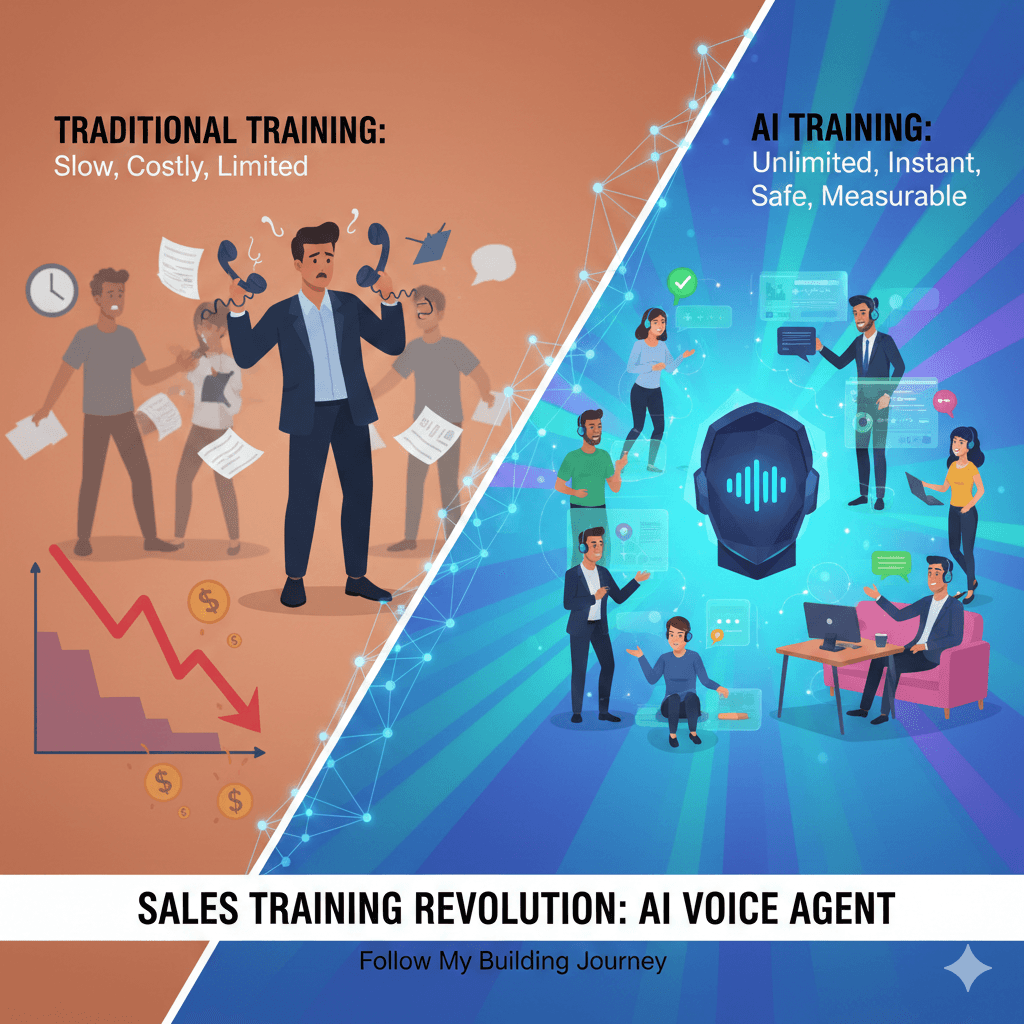
Sales training has a scaling problem. Most companies don't realize it until they're bleeding money and losing deals. Here's how AI voice agents are fixing what traditional training can't.
The Problem With Traditional Sales Training (And How AI Fixes It)
Sales training has a scaling problem.
And most companies don't even realize it until they're bleeding money, losing deals, and burning out their best people.
I'm currently building an AI voice agent that trains sales reps through realistic conversations. The deeper I get into this project, the clearer the gap becomes between how sales training works today and how it could work.
Here's what I've learned.
The 4 Problems With Traditional Sales Training
1. It doesn't scale
Your best sales trainer can only be in one room at a time. They can run maybe 3-4 role-play sessions per day before fatigue sets in.
Meanwhile, you have 20 new reps who need practice. Or 50. Or 200.
The math doesn't work.
So companies do one of two things:
→ Underinvest in training (reps learn on real calls, lose real deals) → Overwork trainers (burnout, inconsistency, turnover)
Neither option is sustainable.
2. Feedback is delayed and inconsistent
In a traditional role-play session, feedback comes after the conversation ends. Sometimes minutes later. Sometimes days later in a group debrief.
By then, the rep has forgotten the exact moment they fumbled an objection.
Worse: feedback quality varies wildly depending on who's giving it. One trainer focuses on tone. Another on talk time. Another on closing technique.
Reps get mixed signals. Improvement slows down.
3. Practice is limited to business hours
Real customer calls happen at 9am on Tuesday. But also at 7pm on Thursday. And 11am on Saturday in some industries.
When can reps practice for those scenarios?
Traditional training happens when the trainer is available. Usually during business hours. Usually when reps would rather be selling.
The result: reps either skip practice or squeeze it into inconvenient slots where they're not fully engaged.
4. Real stakes create fear, not learning
Role-playing in front of peers is awkward. Role-playing in front of your manager is terrifying.
The social pressure makes reps perform instead of experiment.
They stick to safe scripts. They avoid risks. They don't try new approaches.
The whole point of practice is to fail safely. Traditional training rarely creates that safety.
What AI Voice Agents Change
I'm not saying AI replaces human trainers entirely. Great trainers bring empathy, intuition, and strategic thinking that AI can't match.
But AI handles the parts that don't require a human:
→ Repetition → Availability → Consistency → Real-time feedback
Here's what becomes possible:
1. Unlimited practice at any hour
An AI voice agent doesn't sleep. It doesn't get tired after the 15th role-play. It doesn't judge you for practicing the same objection 30 times.
A rep can run a practice call at 6am before their shift. Or at 10pm when they're mentally replaying a lost deal.
This changes the learning curve completely.
2. Instant, structured feedback
AI can analyze a conversation in real-time.
Did the rep talk too much? Flag it immediately. Did they miss a buying signal? Highlight it. Did they fumble the pricing objection? Offer the exact phrase that works.
No waiting for a debrief. No inconsistent opinions. Just clear, actionable feedback after every single practice session.
3. Safe space to fail
There's no audience. No peers. No manager watching.
Just you and the AI.
Reps can try wild approaches. They can fail spectacularly. They can experiment without social consequences.
This is where real skill development happens.
4. Scalable and measurable
AI training generates data.
You can track:
→ How many practice sessions each rep completes → Which objections they struggle with most → How their performance improves over time
Try getting that level of insight from traditional role-play.
Leaders can finally see what's working and where to invest more coaching time.
The Hybrid Future
The best sales training programs will combine both.
AI handles volume: repetition, practice, feedback loops. Humans handle depth: strategy, motivation, complex scenarios.
Trainers become coaches instead of drill sergeants. They focus on the 20% of problems that require human judgment. AI handles the 80% that just needs reps.
This isn't a futuristic prediction. Companies are building this now. I'm building this now.
What This Means For You
If you're a sales leader:
→ Ask how many practice hours your reps actually get per month → Ask how consistent feedback is across your team → Ask whether training scales with your hiring plans
If the answers are uncomfortable, AI voice agents might be worth exploring.
If you're a rep:
→ The people who practice most will win → AI gives you unlimited practice without the awkwardness → Early adopters will have an unfair advantage
This shift is happening faster than most people realize.
Next Steps
I'm documenting my entire build process for an AI sales training agent here on LinkedIn and on this blog.
If you're curious about how this technology actually works, follow along.
And if you're exploring AI for sales training in your organization, book a free strategy call to discuss what's possible. I'm happy to share what I'm learning.
What's your experience with sales training? Does any of this resonate? Let's discuss or connect with me on LinkedIn.

Related Posts

How Meeting Notes Automation Saves Sales Time

AI Automation Services for Marketing Teams

Custom AI Development for Sales Workflows
Ready to Automate Your Sales and Marketing?
We build AI agents and automations that cut manual work so your team can focus on scaling.