


Custom AI Development for Sales Workflows
Custom AI development streamlines sales workflows with CRM automation, faster follow-ups, cleaner data, and scalable growth.
Sales teams do not need more dashboards, more tabs, or more manual follow-up. They need systems that move work forward without adding friction.
"Information does not need to be retyped, copied, chased, or reformatted by hand"
That is where custom AI development makes a real difference. Instead of forcing a sales team to adapt to generic software, a custom AI solution is built around the way the team already sells, reports, qualifies leads, updates CRM records, and communicates across tools like HubSpot, Slack, Notion, Airtable, and n8n. The result is less admin, faster response times, cleaner data, and a sales process that scales without adding headcount just to keep up.
Custom AI development improves sales workflows
Off-the-shelf AI tools can help with isolated tasks, but sales operations rarely break in isolated ways. A rep may lose time pulling account context from the CRM, writing follow-ups after calls, updating deal stages, checking internal notes, and building pipeline reports. Those steps connect to each other, which is why custom AI works so well in sales. It can be designed around the full workflow, not just a single task.
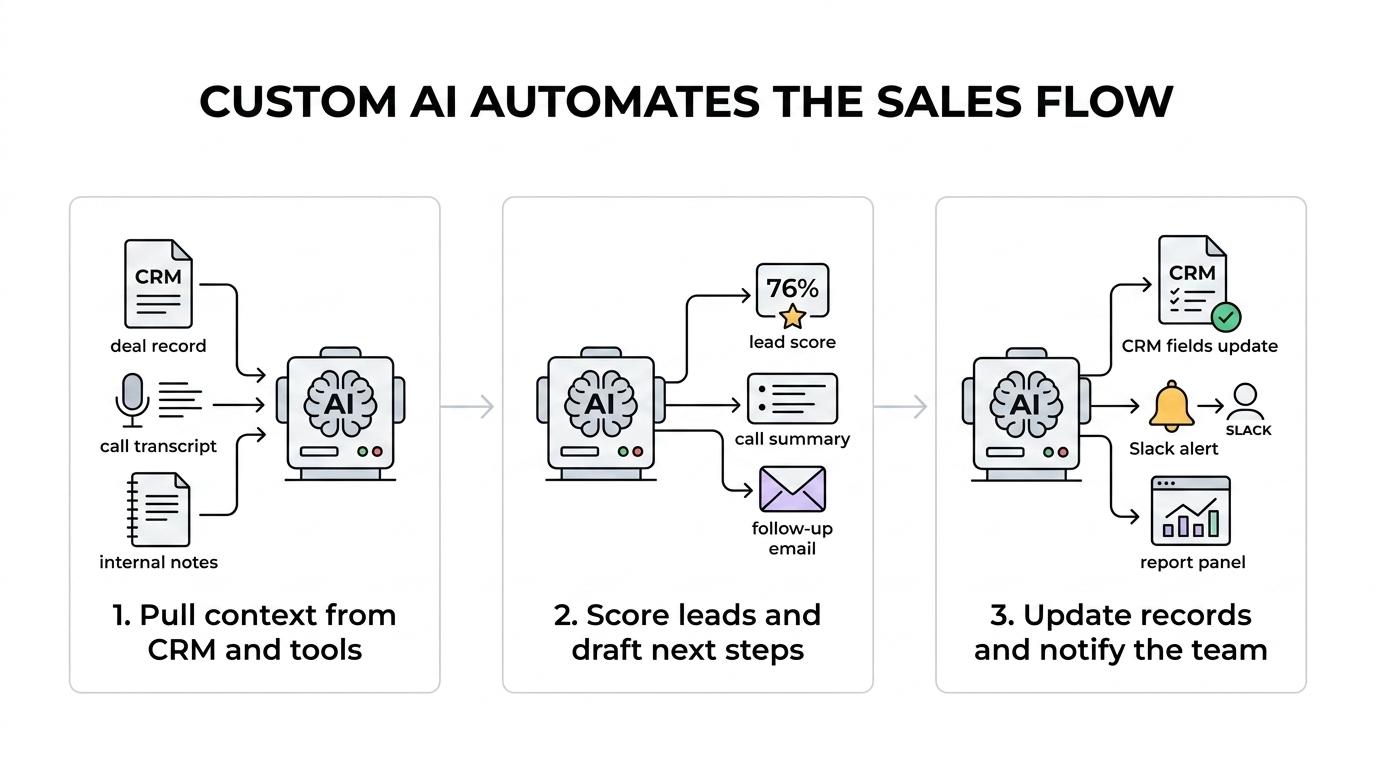
A well-built sales AI system can score inbound leads, summarize calls, draft next-step emails, push updates into the CRM, notify account owners in Slack, and generate reporting automatically. Instead of adding another platform to manage, it turns existing systems into a more active operating layer.
That shift matters because sales performance is often limited by operational drag, not rep effort.
| Sales workflow issue | Custom AI solution | Business impact |
|---|---|---|
| Slow lead qualification | AI lead scoring with CRM and form data | Faster routing, better rep focus |
| Missed follow-ups | Automated post-call and next-step workflows | Higher response rates, fewer lost leads |
| Incomplete CRM records | AI data cleanup and enrichment | Better forecasting and cleaner reporting |
| Manual reporting | Reporting agents pulling from sales and marketing tools | Hours reclaimed each week |
| Inconsistent outreach | AI-assisted personalization and sequencing | More relevant communication at scale |
| Weak forecast visibility | Predictive models for pipeline health | Stronger planning and earlier risk detection |
Sales workflow bottlenecks custom AI can fix
Custom AI is especially valuable when the same friction appears every day. Sales leaders usually recognize the pattern quickly: good leads sit untouched too long, follow-ups depend too much on memory, reporting eats into selling time, and the CRM becomes less reliable every month.
In agency and B2B SaaS environments, these issues tend to compound. A missed follow-up lowers conversion. Poor CRM hygiene weakens forecasting. Slow reporting pulls account managers and sales leaders into admin work. Custom AI development addresses the chain, not just the symptom.
After the workflow is mapped, AI can be applied to high-value points like these:
- lead intake and qualification
- post-call summaries
- follow-up drafting
- CRM field updates
- pipeline risk alerts
- client and revenue reporting
CRM integration for custom AI sales systems
A sales AI system is only useful if it works inside the stack the team already depends on. That usually means CRM integration comes first.
For many teams, the CRM is the source of truth but not the source of speed. Data lives there, yet action still happens in Slack, inboxes, meeting tools, proposal software, and internal docs. Custom AI development connects those environments so information does not need to be retyped, copied, chased, or reformatted by hand.
This is why integration work matters as much as model selection. If an AI agent can read a new HubSpot deal, pull context from Notion, summarize a recent call transcript, and trigger the next task in Slack, the team gets actual workflow acceleration instead of another isolated feature. That is the kind of practical build that creates margin gains.
At Augmentica Labs, this approach is grounded in native stack integration. AI agents are built to plug into existing tools, with the first live agent typically delivered in under two weeks. That keeps adoption high because the workflow feels familiar from day one.
Custom AI development process for sales teams
Strong custom AI projects start with business logic, not prompts. The first step is identifying where time is being lost, where revenue is being delayed, and which workflow can produce the fastest return once automated. In many cases, that first use case is reporting, lead qualification, or post-call admin.
Next comes system design. Data sources are reviewed, CRM structure is checked, and decision rules are mapped. Some use cases need machine learning for scoring or prediction. Others need language models for summarization, drafting, or knowledge retrieval. Many need both, plus automation logic to trigger the right action at the right moment.
Then the solution is deployed in a controlled way, measured, refined, and expanded. That iterative rollout matters. Sales teams benefit more from one production-ready workflow that saves hours now than from a large AI plan that stays stuck in planning.
A practical rollout usually includes:
- Workflow audit: Identify where reps and managers lose time each week
- Use case selection: Choose one sales process with clear ROI potential
- Data review: Clean inputs, remove duplicates, and define required fields
- Agent build: Create the AI workflow inside the current tool stack
- Pilot launch: Test outputs, approvals, timing, and exceptions
- Iteration cycle: Measure time saved, tighten logic, and expand to the next workflow
Sales workflow KPIs for AI automation
Custom AI should be measured like any other revenue-facing investment. If the impact is real, it will show up in both efficiency and pipeline performance.
The clearest metrics usually combine time savings with sales outcomes. That means looking beyond simple usage numbers and tracking whether the workflow produces faster lead response, cleaner records, more consistent follow-up, and stronger conversion through the funnel.
Useful KPIs often include the following:
- Hours reclaimed per rep: Time no longer spent on reporting, data entry, and follow-up admin
- Lead response time: Speed from inbound submission to first meaningful touch
- Lead-to-opportunity rate: Whether qualification and prioritization are improving
- Sales cycle length: Whether automation is reducing delay between stages
- Forecast accuracy: Whether cleaner data and predictive signals improve planning
- Report production time: How quickly managers and clients receive usable reporting
For many teams, the early win is operational. A reporting agent may save 4 to 8 hours per client report. A post-call workflow may remove dozens of manual updates each week. Once those gains are in place, the next layer often affects revenue more directly through faster follow-up, better prioritization, and improved consistency.
Fast custom AI rollout for agency and SaaS sales teams
Digital agencies and B2B SaaS teams often feel the value of custom AI faster than larger enterprises because their workflows are already tool-driven and time-sensitive. They live inside CRMs, messaging platforms, spreadsheets, call recordings, and shared docs. That creates the ideal environment for AI agents that can read context, make structured updates, and trigger action.
It also means the best rollout is rarely a massive transformation project. It is a focused first deployment with a clear target: reduce manual reporting, automate lead handling, improve call follow-up, or surface pipeline risk earlier. Once that workflow is working, the next one becomes easier and more valuable.
Augmentica Labs builds in that rhythm. The goal is not a one-time deliverable. It is a compounding system of agents and automations that reclaim hours, improve margins, and help teams scale without hiring just to handle admin.
Sales AI agents that start with one high-impact workflow
The smartest way to approach custom AI development is to start small enough to move fast and meaningful enough to matter. One workflow can change the pace of an entire sales team when it removes repetitive work from every deal and every rep.
That could be an AI reporting agent, a lead qualification workflow, a post-call automation layer, or a CRM cleanup and enrichment system. Once the first build proves itself, the path forward becomes much clearer, and much more profitable.

Related Posts

How Meeting Notes Automation Saves Sales Time
AI Automation Services for Marketing Teams

AI Integration Services for Existing Stacks
Ready to Automate Your Sales and Marketing?
We build AI agents and automations that cut manual work so your team can focus on scaling.