


AI Integration Services for Existing Stacks
AI integration services connect your existing stack to automate reporting, follow-up, and ops for faster workflows and measurable ROI.
Most teams do not need another platform. They need their current stack to do more.
AI integration services make that possible by fitting automation, language models, and decision support into the tools a team already uses every day. Instead of forcing a disruptive rebuild, the right integration work turns Slack, HubSpot, Notion, Airtable, Google Workspace, and other systems into a faster operating layer for marketing and sales.
For agencies and B2B SaaS teams, that shift is practical, not theoretical. It means fewer manual reports, tighter follow-up after calls, cleaner handoffs between sales and delivery, and more output from the same headcount.
Why AI integration services matter for existing software stacks
A modern stack is rarely simple. Marketing and sales teams often work across CRM, project management, analytics, docs, messaging, call recordings, ad platforms, and internal databases. Valuable information lives everywhere, while repetitive work lands on people.
AI integration services connect those moving parts and turn routine actions into reliable workflows. Instead of copying data from one tool to another, teams can trigger actions automatically, generate outputs on demand, and keep systems in sync without constant manual effort.
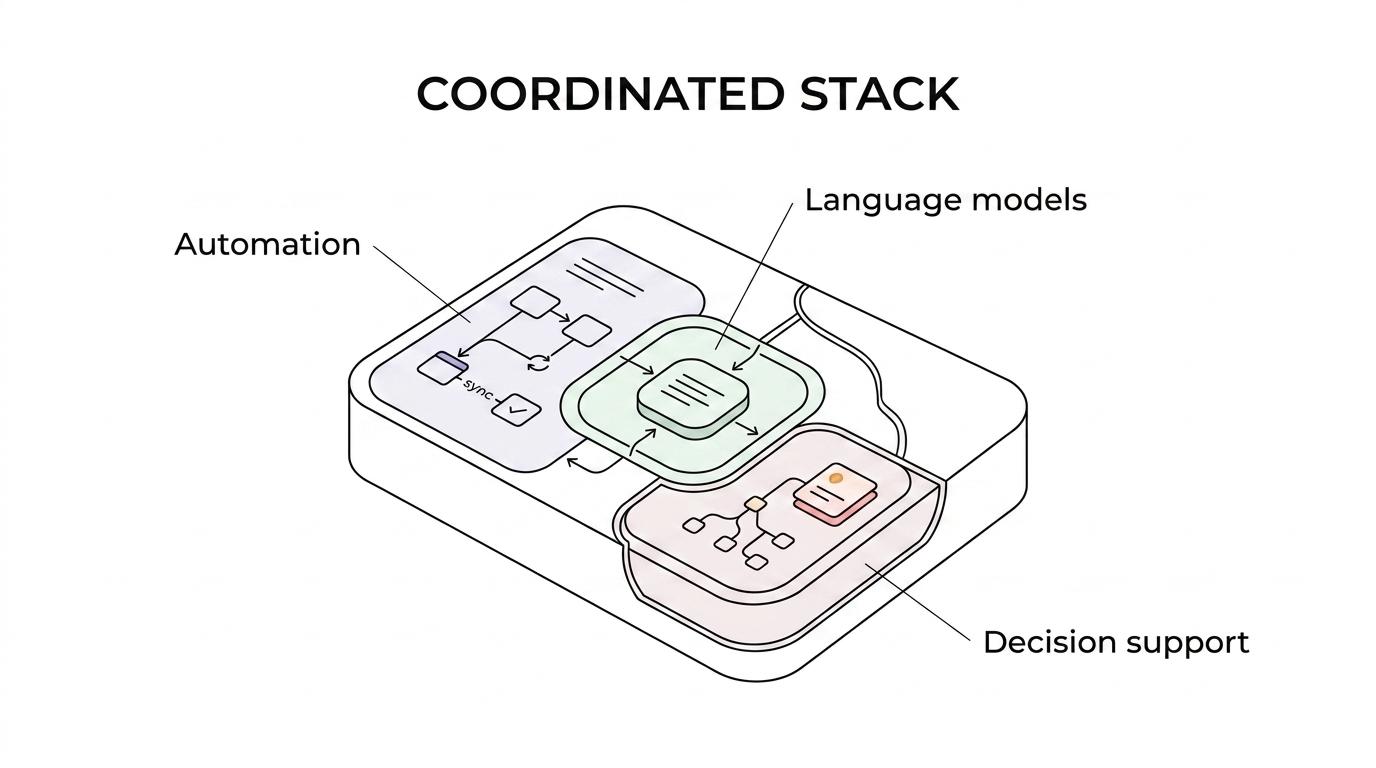
The result is not just speed. It is better consistency, fewer dropped tasks, and more time for work that actually moves revenue.
After that shift starts, teams usually notice gains in a few areas right away:
- Faster reporting
- More consistent follow-up
- Better lead routing
- Cleaner internal documentation
- Less tool switching
How AI integration works inside your current tools
Good AI integration starts with workflow design, not model hype. Before any build happens, the highest-value bottlenecks need to be mapped clearly. In many cases, the best first move is not a flashy chatbot. It is a reporting agent, an onboarding workflow, or a post-call follow-up system that saves hours every week.
At Augmentica Labs, the model is built around fast deployment and iteration. The goal is to get the first useful agent live quickly, then improve and expand from there based on real usage.
That usually looks like this:
- Audit: identify where marketing or sales teams lose the most time, then choose one or two workflows with clear ROI
- Build: connect AI agents and automations to the existing stack, using current tools and data sources instead of replacing them
- Iterate: track hours saved, tighten edge cases, and roll out the next workflow with what was learned from the first
That approach matters because AI projects succeed when they are tied to daily operations. If the agent lives where the team already works, adoption rises. If the output is measurable, expansion gets easier.
AI integration use cases for marketing and sales teams
The most useful AI integrations are usually tied to recurring operational work. Agencies and SaaS teams have plenty of it: monthly reports, call summaries, CRM updates, pipeline qualification, content approvals, client onboarding, and internal knowledge retrieval.
A common pattern is to start with one workflow that is easy to measure. Reporting is a strong example. If an account manager spends four to eight hours preparing a client report every month, an AI reporting agent can reclaim a meaningful block of time while improving consistency.
The same logic applies to sales. After a discovery call, reps often need to summarize the conversation, log next steps, draft follow-up, update CRM fields, and alert the right stakeholders. AI can turn that chain into a near-instant workflow.
| AI integration use case | Connected tools | Typical outcome |
|---|---|---|
| Reporting automation | GA4, Google Ads, Meta Ads, HubSpot, Looker Studio, Sheets | Hours saved on monthly reporting and cleaner client delivery |
| Post-call follow-up | Zoom, Gong, HubSpot, Slack, email | Faster follow-up, better CRM hygiene, fewer missed actions |
| Lead qualification | Forms, HubSpot, enrichment tools, Slack | Better routing and quicker response to qualified leads |
| Knowledge base agent | Notion, Drive, SOP docs, internal wiki | Faster answers for team questions and less repeated explanation |
| Client onboarding automation | Airtable, ClickUp, Slack, forms, CRM | Shorter setup time and fewer manual handoffs |
These are not isolated automations. Done well, they become a connected system where each action improves the next one. A sales call summary updates the CRM, triggers a follow-up draft, alerts the team in Slack, and stores the context for future account work.
AI integration services for reporting, follow-up, and internal ops
Reporting agents are often the clearest first win for agencies. They pull data from analytics and ad platforms, structure it, and produce draft reports or finished deliverables based on the format the team already uses. That cuts repetitive work while giving clients more consistent communication.
Post-call automation is another high-impact service. It can summarize recordings, extract objections, assign next steps, update records in HubSpot, and prepare tailored follow-up messages. Sales teams move faster when admin work no longer sits between the conversation and the next action.
Internal knowledge systems are equally valuable. Many teams re-answer the same questions because SOPs, notes, and historical context are scattered across docs and chat. A retrieval-based AI agent can surface the right answer from approved internal sources, which reduces interruptions and improves execution.
Sometimes the most valuable build is a simple internal dashboard.
When profitability, capacity, pipeline status, and client delivery data are pulled into one place, managers stop making decisions with partial information. AI can flag patterns, draft summaries, and help teams act sooner.
Technical AI integration services without a rip-and-replace project
Strong integration work fits AI into the stack you already run. That often includes APIs, workflow tools, database connections, document stores, and chat interfaces. The end result feels simple for the user, though the backend orchestration may involve several systems working together.
For many teams, that means connecting tools like:
- HubSpot
- Slack
- Notion
- Airtable
- n8n
- Google Workspace
The technical pattern varies by use case. A reporting agent may pull from ad APIs and warehouse data on a schedule. A follow-up agent may listen for call transcripts, run extraction and generation steps, then write outputs back to the CRM. A knowledge base agent may use retrieval-augmented generation so answers come from company-approved documents rather than generic model memory.
This matters for speed. When AI is inserted into current workflows instead of forcing a platform change, teams can start seeing value in weeks, not quarters.
Common AI integration challenges and how they are handled
AI integration is powerful, but it still needs discipline. The biggest issues are usually not model quality. They are data quality, system access, workflow design, and human trust.
Messy CRM fields, unclear ownership, disconnected sources, and weak approval rules can limit results fast. That is why solid integration work includes validation, permissions, and human review where needed, especially for client-facing or revenue-sensitive actions.
A practical delivery process usually accounts for these challenges early:
- Data quality: clean key fields, standardize naming, and define a trusted source before automation expands
- Permissions: control which systems the agent can read from or write to, with clear approval rules
- Human review: keep a review step for high-stakes outputs like client reports, pricing, or outbound messaging
- Adoption: build inside familiar tools so the team does not need to learn a completely new operating model
Security and privacy also matter. Sensitive information should be handled with clear access controls, intentional retention rules, and documented flows between tools. That is especially important for agencies managing client data and SaaS teams working with pipeline or customer records.
Why Augmentica Labs fits agency and SaaS AI integration needs
AI agents and automations for marketing and sales teams that want practical gains from the stack they already have. The emphasis is on speed, measurable time savings, and a rollout model that compounds over time.
That means a first agent can go live in under two weeks, then improve from there. It also means the work is tied to concrete business outcomes: reclaiming 10+ hours per person per week, saving 4 to 8 hours on client reporting, and increasing margin without adding headcount.
The fit is especially strong for teams that already run on tools like HubSpot, Slack, Notion, Airtable, and n8n, and want AI to plug into those systems rather than sit off to the side as a disconnected experiment.
If the current stack already holds the data, the process, and the daily activity, it is a strong foundation for AI integration. The next step is choosing the first workflow that will save real time, prove value quickly, and give the team a better way to operate every week after that.

Related Posts

How Meeting Notes Automation Saves Sales Time

AI Automation Services for Marketing Teams

Custom AI Development for Sales Workflows
Ready to Automate Your Sales and Marketing?
We build AI agents and automations that cut manual work so your team can focus on scaling.